Canada eSIM 2026: Road Trips, National Parks and the US Border
mySIM24 Redaktion · Published 8/1/2026 · Updated 8/1/2026 · 7 min read
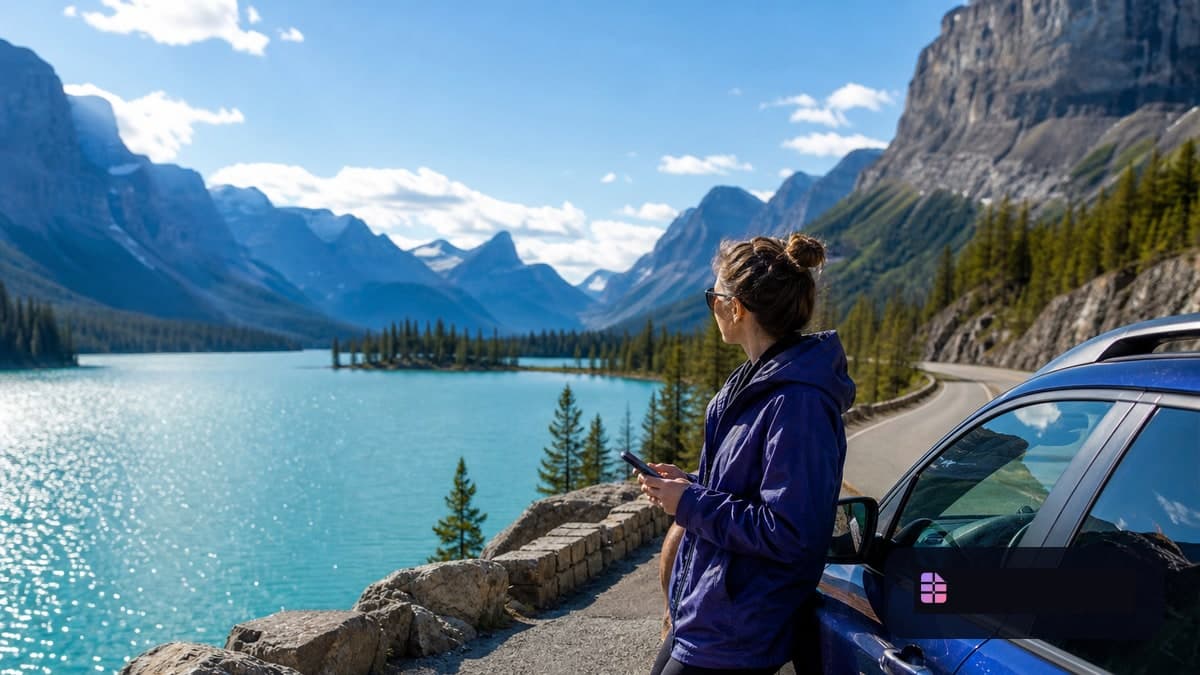
Canada eSIM: plan the route, not just the data allowance
A Canada eSIM is a convenient way to get online as soon as you land, especially if your trip includes a road trip through the Rockies, several domestic flights, camping, or a route close to the United States. You can install a travel data plan digitally before departure and usually keep your home number active on the same phone.
But Canada is not a destination where a travel eSIM guarantees service everywhere. Coverage can change considerably between urban areas, highways, mountain passes and remote trails. Parks Canada specifically warns that cellular service is not always reliable in backcountry and remote areas. Downloaded maps, a charged battery and an independent emergency plan are therefore just as important as the eSIM itself. (parks.canada.ca)
This guide is current as of August 1, 2026. It deliberately avoids blanket coverage promises, invented prices and unsupported claims about individual networks. Always check the destination list, validity period, hotspot policy and network information for the exact plan you intend to buy.
When is a Canada eSIM a good choice?
Canada is outside the EU roaming area, so travellers using a European home SIM should review their provider’s Canada roaming terms before departure. A travel eSIM is often an easier way to separate holiday data from the home plan.
It is particularly useful for:
- multi-stop road trips and immediate internet access after landing;
- navigation, accommodation apps, bookings, messaging and ride-hailing;
- travellers who want to keep their home number for calls or important texts;
- eSIM-only phones and anyone who does not want to swap a physical SIM;
- trips where a US detour is possible.
First, check that your phone supports eSIM and is unlocked for another carrier. See Which devices support eSIM?. Apple states that using two different carriers requires an unlocked iPhone, while supported models can manage a home line and a travel eSIM together. (support.apple.com)
Choosing the right plan: four questions that matter
Does the plan include the United States?
A Canada-only plan can be ideal if you will remain in Canada. If Niagara Falls, Seattle, Alaska, a cross-border shopping trip or a US stopover are part of the itinerary, consider a Canada-US or North America plan. Do not assume that every plan labelled “North America” includes the same countries: read the actual destination list.
When does validity start?
Some plans start when installed; others begin on first connection in the destination. Read this rule before buying and do not activate blindly at the airport. For the technical steps, use How to install an eSIM on iPhone and Android.
Is it data-only?
Many travel eSIMs provide data but no local Canadian phone number. That is sufficient for maps, email, messaging, VoIP calls and most travel apps, but it is not automatically a replacement for conventional calls and SMS.
Is hotspot use permitted?
If you need to connect a laptop, tablet or another traveller, verify tethering rules. “Unlimited” plans can still include fair-use policies, speed reductions or hotspot restrictions. Read Unlimited eSIM and fair use explained before choosing one.
Recommended Dual SIM setup
For many travellers, the simplest configuration is: Canada eSIM for mobile data; home SIM or home eSIM for the phone number. This can keep the home number available for texts while travel apps use the Canadian data plan.
Before leaving:
- Install the travel eSIM according to its activation instructions.
- Label the lines clearly, for example “Home” and “Canada Data”.
- Set the Canada eSIM as the mobile-data line.
- Turn off data roaming on the home line.
- Review automatic mobile-data switching and disable it if it could move data back to the home line.
- Test messaging, maps and any essential authentication process before departure.
Apple explains that iOS 26 can guide travel-eSIM setup and use the travel eSIM for data when both lines remain active. It also cautions that use of the home eSIM can still create roaming charges. (support.apple.com) On Android, menu names differ by manufacturer, but SIM settings should be checked individually for mobile data, roaming, default SIMs and data warnings. Google lists these as configurable mobile-network options on Pixel devices. (support.google.com)
If your bank still sends one-time codes to your home number, read Travel eSIM and banking TAN texts abroad.
Border warning: accidental US roaming can happen in Canada
Near the US border, a phone may connect to a US network even when you have not crossed the border. This can happen in border towns, near lakes, on ferries or wherever the Canadian signal is weak. Canada’s communications regulator, the CRTC, warns about accidental roaming and recommends manually selecting a provider network when necessary. (crtc.gc.ca)
That matters for your home line as well as your travel eSIM. A Canada-only travel plan does not necessarily protect you if the home SIM connects to a US network or if your travel plan excludes the United States.
Border checklist:
- Watch the network name in the status bar.
- Keep data roaming disabled on the home line.
- If a US network appears unexpectedly, manually select a Canadian network where possible.
- Use a Canada-US or North America plan for a genuine US excursion.
- Check the active data line again after returning to Canada.
National parks: an eSIM is not emergency equipment
Banff, Jasper, the Icefields Parkway, Vancouver Island and Newfoundland are extraordinary travel regions, but they should not be treated as continuous-coverage zones. Parks Canada says that cell coverage is not always reliable in remote or backcountry areas and advises travellers to understand emergency options. (parks.canada.ca)
Prepare in three layers:
Download before driving
Save offline maps for the full route, booking confirmations, lodging addresses and essential travel documents. Keep a non-network-dependent navigation alternative.
Protect your data allowance
Use cellular data for navigation and live information, not automatic photo backups or high-resolution streaming. Restrict background updates, enable a data warning and use Wi-Fi for large uploads. Our guide How many GB do I need while travelling? helps you estimate usage.
Plan safety independently of signal
Tell someone your route and expected return time. Carry water, appropriate clothing, power and suitable navigation or emergency communications for the activity. Satellite features can be an additional layer on compatible phones, but they do not replace preparation. See Satellite SOS on holiday.
How much data should you plan for?
For a city break with hotel Wi-Fi, a small or medium plan can often cover maps, messages, tickets and occasional uploads. For a two- or three-week road trip, plan more generously because changing routes, reservations, navigation and sharing travel content all consume data. Heavy video uploads, in-car streaming and hotspot work require substantially more data and a verified hotspot policy.
| Travel style | Practical approach |
|---|---|
| City break with Wi-Fi | Prioritise maps, messages and tickets; consider a small or medium plan |
| Daily road trip navigation | Choose a medium or larger allowance and download offline maps |
| Camping and national parks | Reserve data for essentials; never assume signal |
| Remote work or hotspot | Verify tethering, speed conditions and a larger allowance |
Monitor usage on the device as well as in the provider app. The CRTC also recommends tracking consumption and using data limits or alerts to avoid unexpected charges. (crtc.gc.ca)
Bottom line
A Canada eSIM can make a road trip far smoother: you arrive connected, avoid a physical SIM swap and can keep your home number available. The best result comes from combining the right country coverage with correct Dual SIM settings, offline preparation for remote areas and special attention near the US border.
Install early, read the plan conditions, keep home-line data roaming off and do not rely on signal bars as a safety strategy in national parks.
Sources
- CRTC, “International roaming fees”, updated October 7, 2024: https://crtc.gc.ca/eng/phone/mobile/trav.htm
- Parks Canada, “Emergency contacts”, accessed August 1, 2026: https://parks.canada.ca/voyage-travel/securite-safety/urgence-emergency?wbdisable=true
- Apple Support, “Use eSIM while traveling internationally with your iPhone”, published March 10, 2026: https://support.apple.com/en-us/118227
- Google Pixel Help, “Learn more about eSIMs”, accessed August 1, 2026: https://support.google.com/pixelphone/answer/16115741?hl=EN-GB