Norway eSIM 2026: Road Trips, Fjords and Lofoten Without Data Stress
mySIM24 Redaktion · Published 8/18/2026 · Updated 9/21/2026 · 6 min read
Planning your trip? Compare current eSIM plans for Norway and check your device’s compatibility.
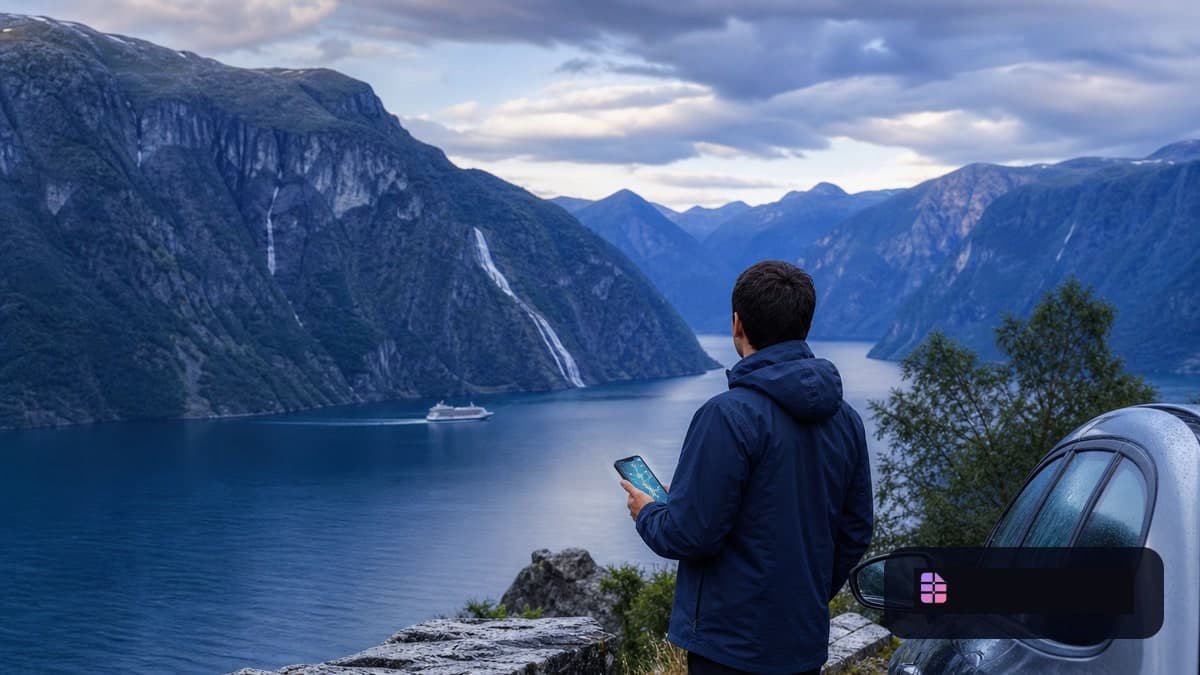
The following data amounts are editorial planning assumptions, not measured app averages or a usage guarantee. Calculate your own daily use × trip days plus a reserve you choose. Video, backups and hotspot use can change requirements substantially.
Norway eSIM 2026: Road Trips, Fjords and Lofoten Without Data Stress
A Norway road trip can combine Oslo, Bergen, fjords, ferries, mountain roads and the Lofoten Islands in one itinerary. Mobile data is useful for more than posting photos: it supports navigation, weather checks, ferry information, bookings and road alerts. But Norway’s geography also means that a good national mobile network does not guarantee signal at every trailhead, mountain pass or remote coastal road.
The key point for many European travellers is that Norway is part of the European Economic Area (EEA). Roam Like at Home therefore applies to Norway for eligible home plans. Before buying a travel eSIM, check whether your existing plan already provides enough EEA data.
Do you need an eSIM for Norway?
Not always. A short city break in Oslo, Bergen or Trondheim can often be covered by your regular plan. A Norway eSIM becomes useful when your EEA allowance is small, your unlimited plan has a roaming fair-use cap, you need extra data for work, or you want to keep your primary number active while using a separate line for data.
That dual-SIM setup is practical for travel: keep your home line available for calls, SMS and verification codes, then choose either your home plan or the travel eSIM for mobile data. Read our travel eSIM buying checklist before choosing a package.
Norway roaming: why EEA status matters
The European Commission’s roaming guidance, updated in July 2026, lists Norway alongside EU countries and the other EEA states in the Roam Like at Home area. During periodic travel, calls, texts and data are generally charged or deducted as they would be at home.
However, check these details before departure:
Your EEA data allowance
With a standard fixed-data plan, your domestic allowance will often be the relevant starting point. With very inexpensive or unlimited plans, an operator may apply a transparent fair-use limit to roaming data. Check the plan app, contract summary or price sheet for the exact EEA data allowance; do not assume that “unlimited” at home means unlimited abroad.
Data roaming setting
Your phone needs data roaming enabled on the line you want to use for data. If you use a travel eSIM, enable roaming only when that provider’s instructions require it and make sure the eSIM is selected as the data line. Turning on the setting does not itself create a charge; the selected line and its tariff do.
Travel versus long-term residence
Roam Like at Home is intended for travel rather than permanent use abroad. A holiday or a multi-week road trip is different from establishing ongoing residence in Norway. For a long stay, review the fair-use policy carefully or consider a local option.
Ferries and flights
Roaming rules apply to land-based mobile networks. On open water or in the air, a phone can connect to a satellite-based network, where regulated roaming protections do not apply. Check the network name on a ferry, use airplane mode if it is unclear, and reconnect in port. See our guide to cruise and ferry roaming.
Coverage in Norway: strong overall, never a promise everywhere
Norway’s communications regulator, Nkom, describes the country’s digital infrastructure as strong and publishes mobile coverage data by technology and geography. Its June 17, 2026 update uses mobile-network data collected at the end of 2025. Nkom also warns that a revised measurement method creates a break with earlier figures, so old and new area-coverage numbers should not be compared casually.
For a visitor, the practical conclusion is simple: cities, populated areas and many main roads are usually straightforward, while remote valleys, mountains, tunnels, islands and hiking areas can produce gaps. Visit Norway specifically advises travellers not to assume mobile coverage in every remote location.
Build an offline plan for fjord routes, high mountain roads, Lofoten and Northern Norway. Download maps and confirmations before you leave accommodation, not after you lose signal.
A reliable Norway eSIM setup
| Phone setting | Recommended approach |
|---|---|
| Main number | Keep it active for SMS, calls and account verification |
| Mobile data | Use your home plan if its EEA allowance is enough; otherwise select the Norway eSIM |
| Data switching | Disable automatic data switching if you want strict cost control |
| Roaming | Enable it only on the line intended to provide data |
| Install timing | Install in Wi-Fi before leaving; check when plan validity begins |
If you receive bank codes by SMS, do not turn off the line that receives them. Our article on travel eSIMs and verification SMS abroad explains the logic in more detail. If your provider uses a QR code, follow the installation steps in our eSIM QR code activation guide.
How much data should you plan?
Your data needs depend on behaviour, not the destination alone. Norway road trips can increase usage because navigation, weather services, traffic alerts, ferry schedules and photo uploads are used every day.
- 2–5 GB: offline maps, messaging, email, schedules and occasional browsing.
- 5–10 GB: daily online navigation, social media, weather and road apps, regular photo sharing.
- 10–20 GB or more: remote work, video calls, cloud backups, frequent large uploads or streaming.
Download maps for the full route, translation packs, music, tickets and booking files while on Wi-Fi. For more examples, see how many GB you need when travelling.
Road-trip preparation matters as much as data
Install the official Vegvesen trafikk app before driving into remote areas. Norway’s Public Roads Administration says it can provide route alerts, mountain-pass information, weather-exposed-road notices and webcams. Weather and road conditions can change, especially on high routes, so check before departure rather than relying on a route planned the previous evening.
Keep a charged power bank and cable in the car. Save accommodation addresses and key numbers offline. Stop safely before checking a map or road alert: a travel eSIM makes information accessible, but it cannot replace safe driving or preparation.
Bottom line
For many European visitors, Norway is not a conventional roaming-cost destination because EEA Roam Like at Home applies. Start by checking your exact plan’s roaming allowance. Add a Norway eSIM if you need more data, want a separate travel-data line, or prefer a backup for a longer itinerary.
Most importantly, do not treat mobile signal as guaranteed wilderness infrastructure. Keep offline maps and documents ready, and check official weather and road information before fjord, mountain and remote-coast stages.
Sources
Article status: August 18, 2026.
- European Commission, Roaming Questions & Answers, updated July 2026: https://digital-strategy.ec.europa.eu/en/faqs/roaming-questions-answers
- Nkom, coverage survey, published June 17, 2026: https://nkom.no/statistikk/nokkeltall-og-interaktive-dashbord/dekningsunders%C3%B8kelsen
- Norwegian Public Roads Administration, Vegvesen trafikk app: https://www.vegvesen.no/en/traffic-information/traffic-information/the-npras-traffic-app/
- Visit Norway, road-safety advice: https://www.visitnorway.com/safe-travel/road-safety/